Selenium (Se) has powerful antioxidant activity. As such, this trace element plays a major role in animal health: immune protection, resistance to infections, prevention of certain neuromuscular diseases, and maintenance of fertility.
Selenium is involved in around thirty major proteins in the body. A deficiency can therefore have significant effects on an animal’s health, and within a relatively short timeframe.
However, assessing selenium status remains a subject of debate, particularly due to the variety of analytical methods available.
Traditional Testing Methods
For over twenty years, selenium has generally been assessed using several analytical approaches :
- Ionisation methods (mass spectrometry or ICP-MS)
- Colorimetry
- Liquid chromatography (HPLC)
The most widely used method for a long time has been indirect analysis via glutathione peroxidase (GSH-Px) by colorimetry. This technique became widely adopted because :
- The equipment was relatively accessible
- Analytical kits were inexpensive
- It provided an estimate of selenium status
In this case, results are generally expressed in units per gram of haemoglobin, whereas direct selenium testing is expressed in µg/L of blood.
Glutathione Peroxidase: An Indirect Indicator
Glutathione peroxidase is a selenium-dependent enzyme stored in erythrocytes (red blood cells).
Its measurement therefore provides :
- A clear indication of the quantity of enzyme present
- An indirect estimate of selenium status in the body
However, due to its storage in erythrocytes, this enzyme has significant biological inertia. It can take two to three months before it reflects a situation of excess or deficiency.
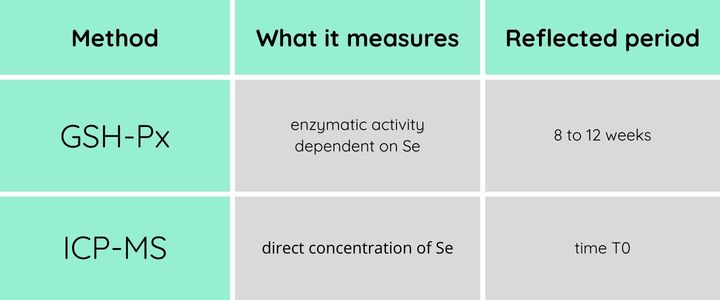
As a result, GSH-Px testing provides more of a picture of selenium status over the 8 to 12 weeks preceding the analysis.
This method remained the reference standard for a long time, particularly when mass spectrometers were rare and expensive in analytical laboratories. However, this inertia can introduce a bias: a recent deficiency may go undetected because the enzyme stored in the erythrocytes remains elevated.
The Contribution of Mass Spectrometry (ICP-MS)
Selenium testing by ICP-MS mass spectrometry offers a different approach.
This technique directly measures the concentration of selenium in the blood, providing an immediate value corresponding to the moment of sampling (time T0).
For most authors and specialists in mineral analysis :
- Results obtained by ICP-MS are more precise
- They reflect the actual situation at the time of sampling
It is therefore important to understand that the two analyses do not answer the same biological question :
Clinical Relevance for the Veterinarian
In practice, a veterinarian may be called to a farm where clinical signs suggest a selenium deficiency.
If this deficiency is recent (less than one to two months) :
- GSH-Px testing may appear normal or at the lower limit
- Whereas ICP-MS testing will reveal an actual deficiency, provided the matrix (nature of the sample) is blood
Mass spectrometry therefore allows for a more reliable assessment of the animal’s current status.
Analysis on Other Matrices
ICP-MS also makes it possible to analyse other biological or environmental matrices.
For example :
- Hair, which provides information on the 6 to 8 weeks preceding the sample
- Forages, to assess their trace element content before or at the time of cutting
- Dietary supplements
- Drinking water
These analyses provide a comprehensive overview of trace element exposure in the farming environment.
Iodolab’s Approach
At the Iodolab laboratory, the plan is to maintain glutathione peroxidase testing by liquid chromatography (HPLC).
Indeed, beyond assessing selenium status, this enzyme also serves as a relevant indicator of oxidative stress in the animal.
Conclusion
The choice of testing method therefore depends on the question being asked :
- ICP-MS: precise assessment of selenium status at the time of sampling, when the matrix is blood
- ICP-MS: assessment of selenium status in the 8 weeks prior to the clinical examination, when the matrix is hair
- GSH-Px: retrospective view of oxidative balance and selenium intake over several weeks
These approaches are therefore complementary in assessing the health and nutrition of farmed animals.