Laboratory analysis is a valuable tool in veterinary medicine. However, the sample received must be usable. At IODOLAB, we are committed to providing precise, reliable, and diagnostically useful results. But the quality of the analysis begins… at the moment the sample is collected. Here are the key points to follow to optimize each submission, avoid returns or interpretation errors, and choose the right type of sample according to your clinical objective.
The importance of clinical information
Too often, clinical information is forgotten. Yet this clinical context is essential to guide the interpretation of results. Symptoms, date of onset, ongoing treatments, progression of the health status… This information enriches the biological interpretation and can avoid many misunderstandings.
Please always include it with your analysis request.
Choosing the right collection tube
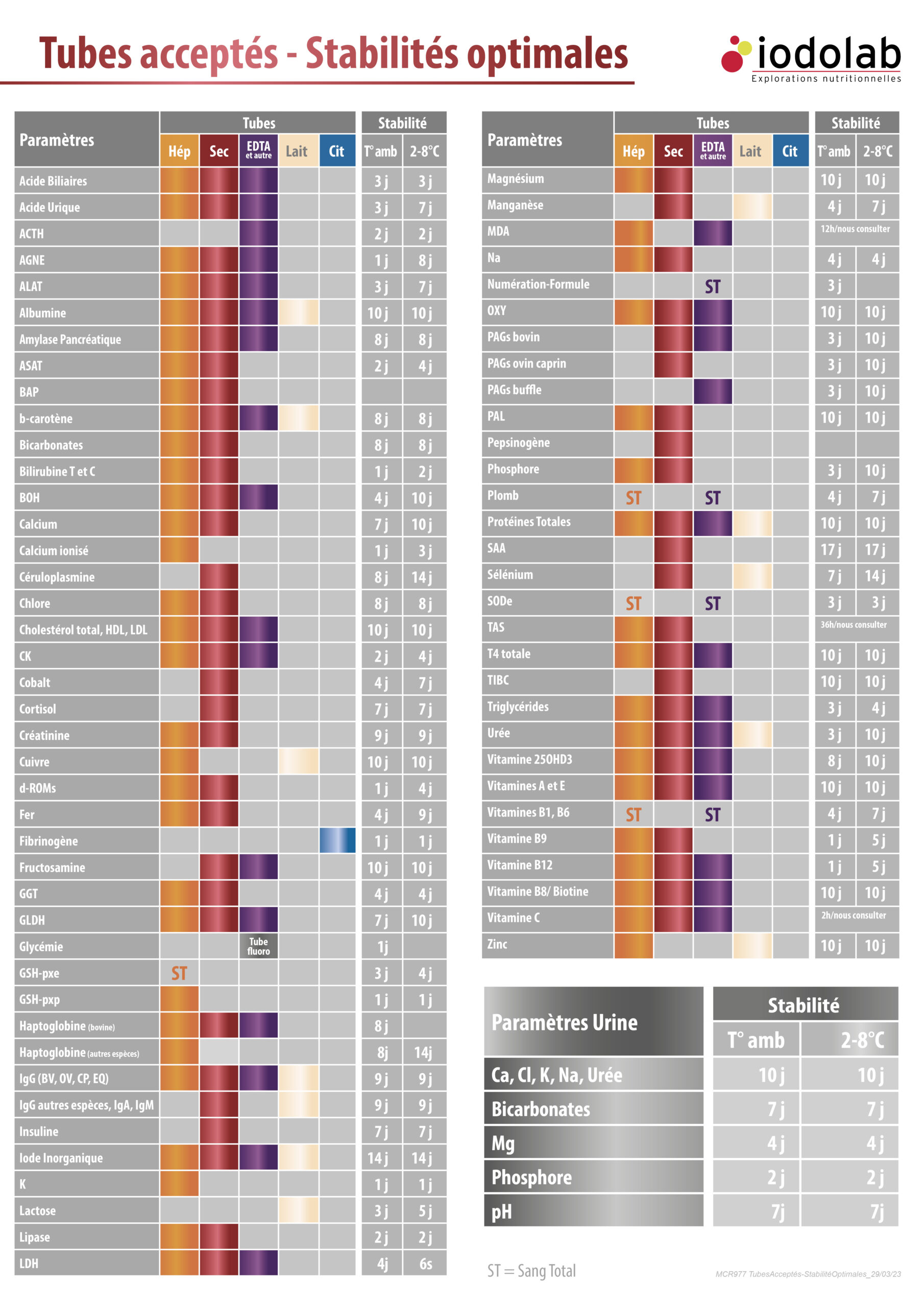
The type of tube is fundamental : it determines the analyses that can be performed. It must be adapted :
To the type of test :
Biochemistry: serum tube (with or without separator gel) or lithium heparin tube.
Red blood cell pellet analysis: whole blood is required (not a serum tube, as a clot forms).
To the animal species : the volume collected must correspond to the size and condition of the animal.
📄 Find here the summary PDF document of accepted tubes.
💡 Note : an underfilled tube distorts results because of excess anticoagulant.
Good sampling practices
- Use an appropriate syringe.
- Remove the needle before transferring the blood into the tube.
- Mix gently by inverting the tube several times (do not shake).
- Respect the order of draw if several tubes are required:
Serum without additive → Citrate → Serum with additive → Heparin → EDTA
Avoid anticoagulant errors
- EDTA: chelates metals. Must not be used for Zn, Fe, Ca, Mg measurements.
- Lithium heparin: suitable for biochemistry, electrolytes, acid–base analysis.
- Citrates: incompatible with Ca, enzyme, electrolyte measurements.
- Fluorides: only for glucose measurement.
An error here may make the sample unusable.
Beware of pre-analytical interferences
Certain conditions can distort results :
- Lipemia : post-prandial. Avoidable with a 12-hour fast.
- Hemolysis : often linked to poor technique or too long a delay before centrifugation.
- Icterus : affects absorbance and certain measurements (e.g. creatinine).
- Light : degrades vitamins A, E, D3 → protect with aluminium foil.
Shipping conditions : the right timing makes the difference
- Store refrigerated (4°C) before shipment, for a maximum of 48 hours.
- Ship from Monday to Wednesday only, to avoid samples being blocked in transit during the weekend.
- Avoid expired tubes: risk of contamination or loss of anticoagulant efficiency.
IODOLAB offers simple logistics :
Shipping via Chronopost : labels available on request or to print here.
Fixed cost: €15 excl. VAT, regardless of the number of samples.
Home collection option : +€14 excl. VAT (request here).
💡 Tubes received before 11 a.m. are separated and prepared for analysis the same day.
📦 TNT and DHL also work very well.
Sample storage and recovery
- Primary and secondary tubes are stored for 2 weeks.
- After that, they are systematically destroyed.
- If you wish to recover the sample, make a specific request beforehand.
Special cases : pooled samples
Few methods are validated to analyse pooled samples. This may dilute the pathogen load or mask certain abnormalities.
The NF U47-600-1 standard also specifies that the result of a pooled sample is not necessarily representative of individual analyses.
IODOLAB recommends favouring individual samples, unless otherwise indicated; individual testing will always be performed rather than pooled testing.
Choosing the sample type : blood, urine, hair, other ?
The type of sample depends on the clinical issue.
- Blood : ideal for acute conditions, it reflects the metabolic state at time t = 0 (day of sampling).
- Hair : better suited for chronic conditions, nutritional disorders or supplementation monitoring, because it provides an indication over the period t-6 weeks to t0.
- Urine, faeces, swabs : useful depending on the requested tests (microbiology, parasitology…).
How to properly collect a hair sample?
- Sampling with clippers on the lateral part of the neck (or under the mane in horses).
- Area: 20 to 30 cm long.
- If the hair is too long :
- Make a first clipping 2 cm from the skin (to discard).
- Then shave close to the skin and send this second cut.
- Place the hair in a plastic ZIP bag, then in a stamped envelope.
- Send by post, with the analysis request form available on www.iodolab.com.
💡 No specific storage or shipping precautions are required for hair samples.
Summary
A properly collected, stored and shipped sample allows our team to provide reliable results, without technical bias. Respecting best practices improves diagnostic quality, reduces the risk of errors and avoids delays.
💡 Quick checklist :
✔ Correct tube, correct volume
✔ Anticoagulants respected
✔ Clinical information and analysis request provided
✔ Refrigerated storage
✔ Shipment at the beginning of the week